
Overcoming Digital Bottlenecks: How Should Enterprise Technical Architecture Be Designed When Scaling Your Business?

Barış Akın
Skript Digital
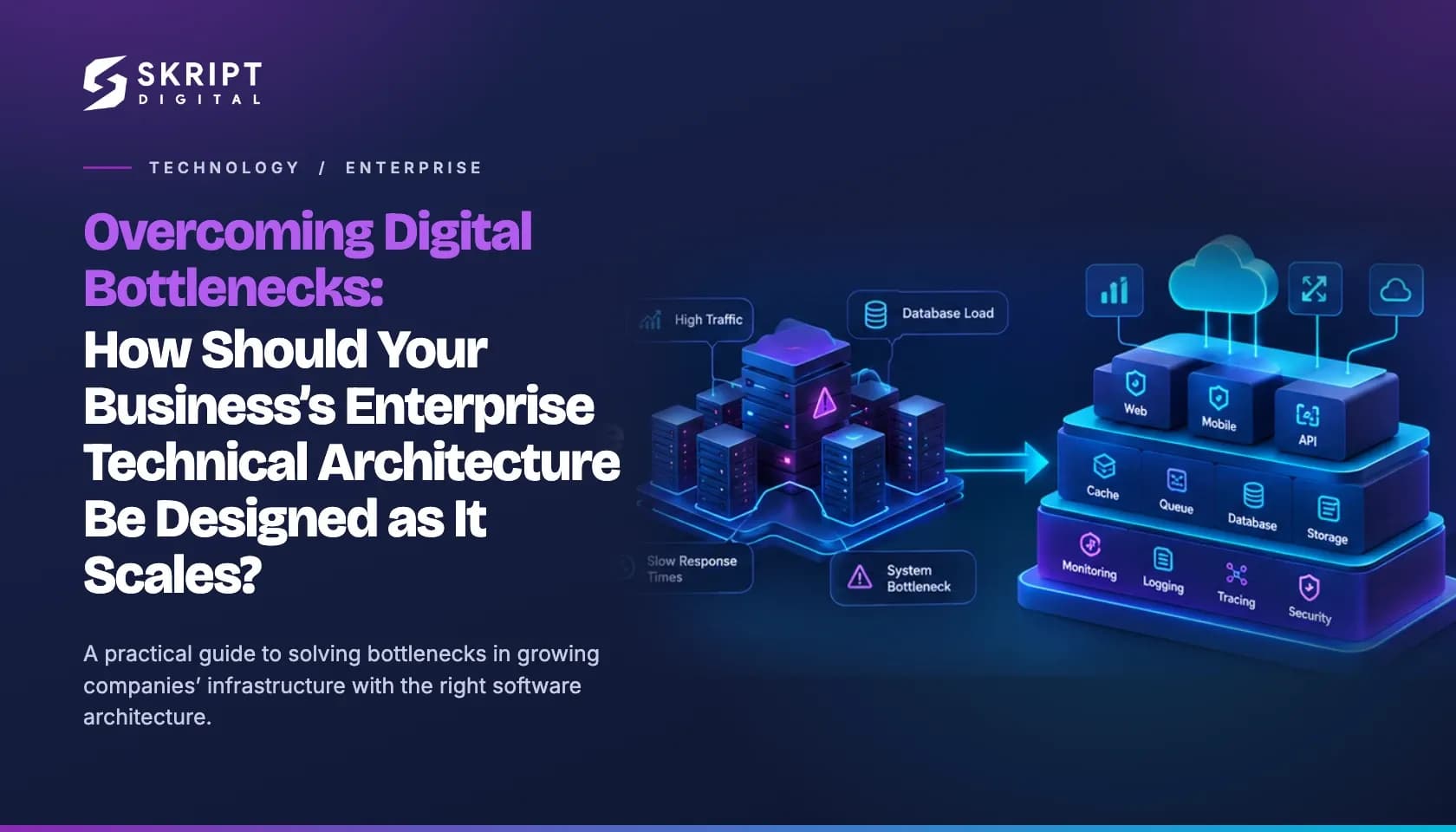
As companies scale, their digital infrastructure does much more than simply serve a larger user base. It has to handle growing data volumes, heavier transaction throughput, complex system integrations, and intricate business logic. An application architecture that performs seamlessly in the early stages can quickly hit a wall as the business grows—leading to performance degradation, high latency, database saturation, timeout errors, and mounting operational overhead.
Designing an enterprise-grade software architecture is never just about handling today's traffic or user counts; it is about engineering for future scalability, fault tolerance, and resilience. The core philosophy of an enterprise approach isn't stacking more technologies together—it is about distributing workloads across the right layers to ensure the system scales in a controlled, predictable manner.
1. What Is a Digital Bottleneck, and Why Do Quick Fixes Fail?
A bottleneck occurs when a specific component in a software system is subjected to a load that restricts the performance of the entire application. Typical symptoms include:
- Spikes in API response times,
- Persistently high database CPU utilization (90%+),
- Cascading timeout errors during peak concurrent requests,
- Message queues backing up faster than workers can drain them.
The Vertical Scaling Trap
When performance issues strike, the default reaction is often a quick hardware fix: provisioning a server with more CPU and RAM (vertical scaling). However, this is merely a temporary band-aid. As growth continues, structural limitations within the application architecture will inevitably resurface. In enterprise systems, the ultimate goal is not just to scale vertically, but to ensure that individual components can scale horizontally on demand.
Is your growing company's software infrastructure struggling with traffic spikes? Schedule a consultation with our expert team to create a secure migration plan from your monolithic structure and build an enterprise-grade scalable architecture.
2. Traffic Flow and Critical Path in Modern Systems
A modern digital platform is far more than an isolated frontend talking to a backend. A typical request path spans multiple infrastructure tiers:
Plaintext

A breakdown or latency spike at any link in this chain can degrade the entire user experience. For instance, even if the application layer can process 10,000 requests per second, a database bottleneck capped at 500 complex concurrent queries will choke the actual capacity of the entire system.
3. From Monolithic Limitations to Domain-Driven Boundaries
Monoliths are not inherently flawed. In early-stage projects, they accelerate time-to-market, simplify deployment pipelines, and keep operational overhead low. However, as organizations scale:
- Core domains—such as authentication, order management, billing, notifications, and reporting—become tightly coupled.
- A minor modification in a single module forces a full application rebuild and redeployment cycle.
- A high-traffic spike in one isolated feature consumes shared resources across the entire application pool.
The Solution: Rushing headfirst into microservices often creates a distributed monolith. The pragmatic approach is to analyze business domains and draw clean bounded contexts around areas that genuinely require independent scaling or development.
4. Pillars of Enterprise Architecture
Sustaining a high-growth enterprise infrastructure requires distinct layers with clearly defined responsibilities:
A. Load Balancers
Prevents traffic concentration on a single application instance by distributing incoming requests across a cluster. Health check mechanisms automatically isolate unhealthy instances from the traffic pool.
B. API Gateways
Acts as a centralized entry point, shielding internal microservices from direct client exposure. It handles cross-cutting concerns such as authentication, rate limiting, request routing, API versioning, and payload validation.
C. Caching Layers (e.g., Redis)
Offloads repetitive read traffic from the primary database by caching frequent product catalogs, configuration flags, and session states in memory. (Key considerations: Cache invalidation, TTL management, and data consistency).
D. Message Queues (Asynchronous Processing - RabbitMQ / Kafka)
Decouples non-critical, time-consuming tasks from the main HTTP request-response cycle—such as sending confirmation emails, generating invoices, or syncing with ERP systems. Users receive instant responses while background workers process tasks asynchronously.
E. Database Scaling Strategies
- Index and Query Optimization: The foundational, most cost-effective first step.
- Read Replicas: Splitting heavy read workloads off the primary database to dedicated read replicas.
- Partitioning and Sharding: Logically or physically breaking apart massive data sets as data volume scales.
F. Observability
"The system feels slow" is never an actionable diagnostic. Enterprise architectures rely on three core pillars of observability:
- Logs: What happened?
- Metrics (Prometheus / Grafana): What are our CPU, memory, latency, and error rates?
- Distributed Tracing (OpenTelemetry): Tracking a single request path across microservices to isolate exact latency anomalies.
5. Curating the Right Technical Stack
Every project demands a tailored technology stack. Adopting trendy frameworks blindly only inflates operational complexity. A balanced, modern enterprise stack typically features:
- Frontend: Next.js / React
- API Layer: NestJS / Node.js or Go
- API Gateway: NGINX / Kong
- Cache & Queue: Redis, RabbitMQ / Kafka
- Database: PostgreSQL / Distributed SQL
- Orchestration & Infrastructure: Docker, Kubernetes, Cloudflare (CDN), AWS/Azure/GCP
Want to spot bottlenecks in your system and start scaling before it's too late? Join our free architectural assessment session to analyze your infrastructure and prepare for growth today!
6. Conclusion: Scalability is an Engineering Culture, Not a Tech Stack
Building a scalable digital infrastructure isn't just about dropping buzzwords like Kubernetes, Kafka, or gRPC into a pitch deck; it is about understanding business growth curves and anticipating architectural constraints before they hurt revenue.
An application serving a few thousand users today may experience exponential traffic surges tomorrow. The ultimate hallmark of an enterprise architecture is that when traffic multiplies, you don't rewrite the system from scratch—you independently scale the precise tiers that need room to grow. Treat scalability not as a feature, but as a core engineering mindset aligned with business growth.