
Why Should Corporate Website Architecture Be Revamped?

Hilal Güzel
Skript Digital
Why Should Corporate Website Architecture Be Revamped?
Corporate websites are no longer mere digital storefronts displaying a company’s services and contact information. In the B2B landscape, a website has evolved into an indispensable engine for brand communication, product and service delivery, lead generation, content marketing, technical integrations, and sales enablement. When building a modern enterprise web presence, focusing solely on visual design is no longer enough; decision-makers must evaluate whether the underlying Content Management System (CMS) and technical architecture can support long-term business growth.
In traditional monolithic CMS platforms, content management, frontend delivery, and backend logic are tightly coupled. While this approach offers convenience during initial setup, it frequently creates architectural bottlenecks when scaling, such as distributing content across multiple platforms, engineering custom user experiences (UX), optimizing site performance, or integrating with legacy enterprise systems.
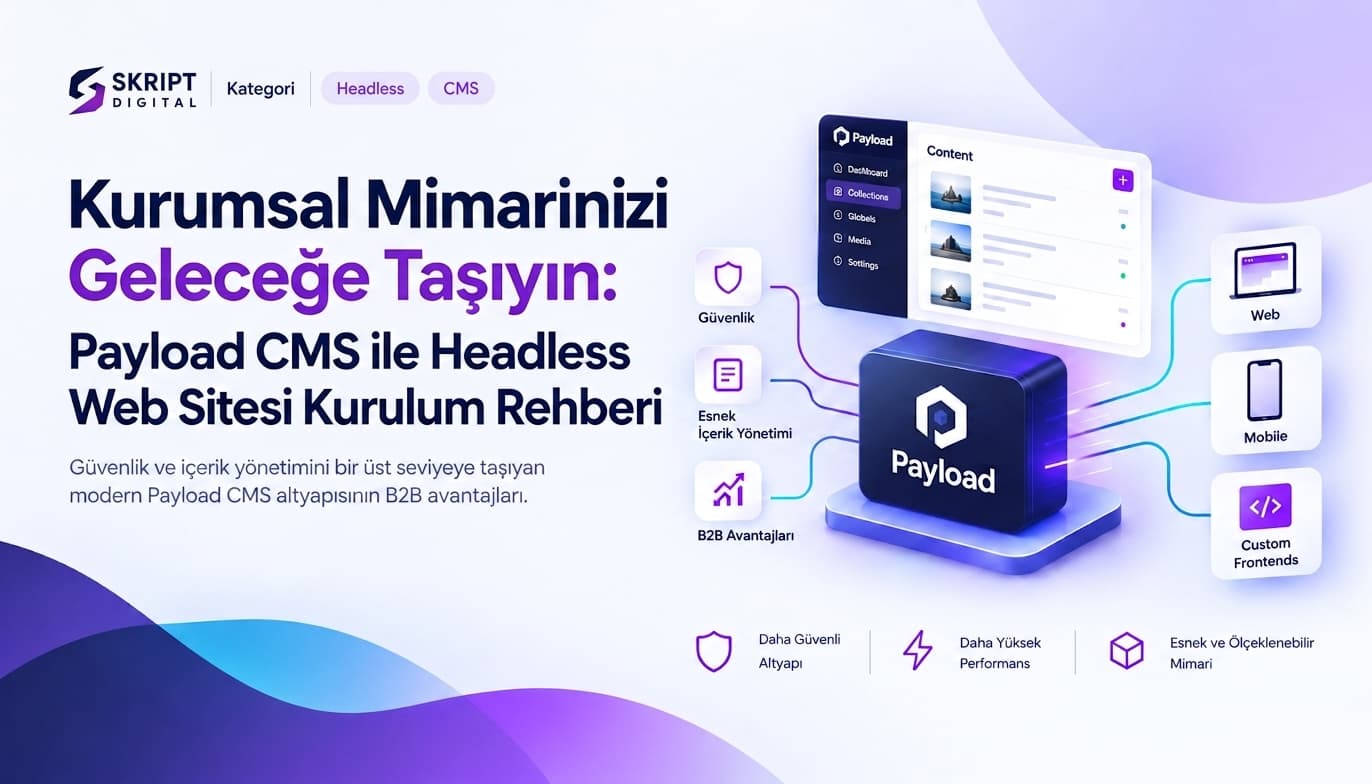
A Headless CMS architecture decouples the content management layer from the presentation layer (frontend). Content is managed centrally and served via APIs to websites, mobile apps, custom portals, or any digital touchpoint.
Payload CMS stands out as a powerful solution within the modern JavaScript and TypeScript ecosystem. Built natively to work alongside Next.js, its open-source foundation, customizable admin panel, robust API capabilities, and flexible database options offer an adaptable technical foundation for enterprise-grade projects.
What Is Payload CMS?
Payload CMS is an open-source, TypeScript-native, full-stack content and application development platform designed for seamless integration with Next.js. Far beyond a conventional CMS, it combines an admin interface, database ORM, authentication, role-based access control, REST and GraphQL APIs, file management, and custom business logic within a single unified codebase.
A key differentiator of Payload CMS is code-first content modeling. Developers define collections, fields, user roles, access control policies, relationships, and schema directly in code.
This architecture is essential for B2B enterprises outgrowing cookie-cutter CMS templates. Corporate content structures vary wildly across industries: a software company’s product matrix, a manufacturer’s SKU catalog, a consulting firm’s service portfolio, or a SaaS company’s solution map each require a bespoke schema. Payload CMS allows organizations to build a digital architecture tailored to their operational reality rather than constraining business processes to fixed software schemas.
What Is a Headless CMS and How Does It Benefit Enterprises?
In a Headless CMS architecture, the content layer is completely detached from the presentation layer. The CMS manages content and serves it via structured APIs, while the frontend is built independently using modern frameworks like React or Next.js.
This separation offers crucial operational flexibility for enterprise teams. A marketing team can update a product page or service listing in Payload CMS, while engineering renders that data on the web using a dedicated design system and optimized UX.
The exact same content object can simultaneously feed a native mobile app, a customer portal, or an IoT display, eliminating duplicate data entry and maintaining a single source of truth across channels.
From an engineering perspective, decoupling protects the stack against technical debt. Replacing or upgrading the frontend stack in the future does not require migrating or replacing the underlying CMS or database layer, turning headless architecture into a core component of long-term digital transformation.
Why Is the Payload CMS + Next.js Stack So Effective?
One of Payload’s biggest advantages is native, full-stack integration with Next.js. This pairing creates an end-to-end development experience across frontend, backend, and CMS workflows.
Next.js provides enterprise-grade frontend features, including server-side rendering (SSR), static site generation (SSG), incremental static regeneration (ISR), dynamic routing, and built-in edge performance optimization. Meanwhile, Payload manages the underlying data layers, authorization, and administrative flows.
For enterprise teams, working within a unified TypeScript environment eliminates context-switching and reduces integration overhead. Sharing types between the content model, API layer, and frontend components ensures type safety across the entire application lifecycle.
Architecting an Enterprise Website with Payload CMS
Successful Payload CMS deployments begin with domain modeling rather than writing code. Organizations must first establish a comprehensive content strategy and data taxonomy.
In an enterprise web environment, common entities include pages, services, product lines, solution verticals, team profiles, thought leadership articles, case studies, client logos, and media assets.
Payload structures these entities as either Collections or Globals. Collections handle repeatable data entries, such as blog posts, case studies, or product catalogs. Globals manage single-instance site constructs, such as global navigation menus, footer configurations, core company info, or site-wide banners.
Structuring content this way ensures clean data modeling and produces an administrative UI tailored directly to internal business workflows.
Recommended Technical Infrastructure for Payload CMS
Payload CMS operates natively within the Node.js and Next.js ecosystems. It can be initialized as a standalone application or embedded directly into an existing Next.js codebase.
System behavior, data models, access controls, hooks, and API configurations are defined centrally within the main configuration file.
On the persistence layer, Payload supports databases including PostgreSQL, MongoDB, and SQLite. For enterprise projects, selecting a database engine requires evaluating data complexity, relational query demands, scalability requirements, backup infrastructure, and existing compliance mandates.
PostgreSQL is often the preferred choice for B2B architectures with complex, highly relational data models, such as interconnected products, categories, buyer personas, enterprise solutions, and localized assets.
Content Modeling Strategies in Payload CMS
Content architecture determines how effectively a system scales over time. Enterprise modeling must account for immediate requirements while planning for future business units, product lines, and digital channels.
For example, a B2B SaaS company might model a Products collection to include core metadata such as title, slug, and positioning statement, along with technical specifications and documentation links. It can also link associated solution verticals, integration partners, target industries, rich media assets, and structured SEO fields.
Similarly, a Services collection might incorporate structured fields for core capabilities, business outcomes, service process steps, FAQs, case study references, and primary call-to-actions.
Enforcing these schemas at the code level gives developers control over data integrity, while content managers gain structured form fields to publish content safely without breaking visual layouts.
Securing Enterprise Payload CMS Environments
In enterprise software procurement, security carries equal weight to feature availability and visual design. A CMS manages more than copy and images; it handles user permissions, internal workflows, customer form submissions, and proprietary enterprise data.
Payload CMS features a granular access control system. Authorization rules can be defined dynamically at the Collection, Global, or individual Field level based on user roles and request context.
This enables fine-grained access policies in corporate environments. Content Editors can write and edit blog posts or news items but cannot alter product schemas or pricing tables. Product Managers maintain full access to product collections but restricted rights to global site settings. Admins manage global platform capabilities, user provisioning, and webhooks.
At the infrastructure level, enterprise security extends beyond the application layer. Proper deployment requires securing database connections, managing environment variables safely, enforcing HTTPS/TLS, implementing content delivery networks with DDoS protection, establishing automated backup policies, and maintaining central audit logging.
Key Benefits of Payload CMS for B2B Enterprises
B2B digital platforms must organize and serve diverse content types across multi-step buyer journeys. Technical documentation, solution pages, enterprise pricing structures, customer stories, localized landing pages, and lead captures often coexist within the same platform.
Payload CMS addresses these needs through several key capabilities. Custom Data Modeling allows teams to build administrative interfaces aligned precisely with internal business processes rather than forcing business logic into standard blogging software formats.
Decoupled Workflows enable marketing and editorial teams to manage content independently while frontend developers build and optimize user experience without content bottlenecks.
Future-Proof Reusability ensures that existing content models and API endpoints can immediately feed new web properties, localized sites, or mobile apps as the enterprise scales.
Managing Multi-Language and Multi-Region Sites
For global B2B operations, multi-language support requires more than automated machine translation. It demands granular control over localized content variations, URL routing strategies, region-specific metadata, and approval workflows.
Payload CMS includes built-in Localization capabilities that operate directly at the field level. Language support is configured globally, allowing specific fields, such as product summaries or localized page copy, to be localized while keeping structural attributes consistent across all locales.
This enables centralized global content operations without sacrificing regional messaging accuracy.
SEO Engineering and Search Performance
Modern B2B SEO depends heavily on technical execution: structured data, page rendering speed, canonical URL management, semantic HTML tags, and clean metadata routing.
A headless frontend architecture provides complete control over the markup rendered to search crawlers. Frameworks like Next.js allow teams to generate metadata dynamically, implement structured JSON-LD schemas, enforce strict canonical rules, and deliver optimized Open Graph cards for social sharing.
On the CMS side, SEO requirements can be integrated directly into content schemas. Fields like meta title, meta description, URL slug, social preview images, and canonical tags can be defined explicitly within the code.
A CMS provides the structural tools for technical SEO, while search performance ultimately relies on high-quality content, site speed, clear technical architecture, and strong search intent alignment.
API-Driven Architecture: REST and GraphQL
The core strength of a headless architecture is its ability to distribute data programmatically across distributed systems. Payload CMS generates fully featured REST and GraphQL APIs out of the box based on the defined collection schemas.
The REST API is ideal for standard HTTP integrations, webhooks, and third-party service syncing. The GraphQL API allows clients to query exact data fields, reducing payload sizes, minimizing network requests, and optimizing frontend performance.
For B2B organizations, this converts the CMS from a simple web admin panel into an enterprise API hub capable of serving internal dashboards, mobile apps, partner portals, and customer-facing web applications.
Enterprise System Integrations
Corporate web platforms do not exist in isolation. They must continuously sync data across Customer Relationship Management platforms, Enterprise Resource Planning databases, marketing automation platforms, support portals, and authentication providers.
Payload’s Node.js backend foundation makes custom integrations straightforward. ERP systems can sync product catalogs or inventory status from platforms like SAP or NetSuite to display on customer-facing pages.
CRM platforms like HubSpot or Salesforce can receive web form submissions automatically via API hooks. Single Sign-On solutions can integrate enterprise authentication providers like SAML, OAuth, Okta, or Azure AD for staff and customer portals.
Establishing clear systems of record during project planning ensures data flows smoothly between the CMS and core enterprise software.
Performance, Optimization, and Scalability
Digital performance directly impacts conversion rates, search rankings, and user engagement. For content-heavy B2B platforms, scalability requires careful planning across both the frontend rendering layer and the backend content layer.
Combining Payload CMS with Next.js provides granular control over performance strategies. Hybrid Rendering utilizes Static Site Generation for high-traffic landing pages, Incremental Static Regeneration for frequently updated content, and Server-Side Rendering for personalized user portals.
Asset Optimization leverages modern image delivery pipelines with WebP and AVIF generation, automatic responsive resizing, and edge CDN caching. Database Optimization ensures proper indexing on frequently queried database fields and optimizes relational lookup operations.
True enterprise scalability involves holistic architectural planning, including CDN edge caching, optimized database queries, asset storage strategies, and robust server infrastructure.
Self-Hosted vs. Managed Infrastructure
Data sovereignty, compliance requirements, and custom infrastructure policies often dictate how enterprises deploy software. Payload CMS’s open-source architecture allows organizations to run self-hosted deployments in their own environments.
Deploying in a self-hosted environment allows infrastructure control over platforms like AWS, Azure, Google Cloud, or private Kubernetes clusters tailored to internal security and compliance policies. Custom CI/CD pipelines can integrate deployment workflows directly into corporate GitHub Actions, GitLab CI, or Jenkins pipelines.
However, self-hosting requires internal ownership of server security, database backups, disaster recovery, continuous monitoring, and framework updates. It offers complete data ownership and deployment flexibility, provided the organization maintains the operational capacity to manage its infrastructure.
Evaluating Payload CMS for Your Organization
Payload CMS is well-suited for organizations that require custom content modeling, precise frontend control, and a modern TypeScript stack designed to support multiple digital channels.
Ideal use cases include B2B enterprises managing complex entity structures such as products, solutions, verticals, partners, and multi-language assets. It is also ideal for organizations building multi-tenant web platforms, customer portals, or combined web and mobile ecosystems, as well as engineering teams seeking a headless solution built natively within modern React and Next.js environments.
For small sites with standard layouts and minimal integration needs, traditional or low-code site builders may suffice. Payload CMS provides the most value where content management intersects with custom software engineering.
Monolithic CMS vs. Headless Payload Architecture
In a monolithic CMS, frontend and backend are tightly coupled, developer experience is restricted by theme engines or plugin APIs, and content delivery is largely limited to web-only template rendering.
In a headless Payload CMS architecture, frontend and backend are fully decoupled. Developers gain full code control using modern TypeScript, React, and Next.js, while content can be delivered across multiple channels via REST and GraphQL APIs. Data customization relies on code-first schemas rather than rigid third-party plugins, significantly reducing attack surface through API abstraction and isolated frontends.
Best Practices for Enterprise Payload Implementations
Building an enterprise-grade platform on Payload CMS requires careful technical planning. Establish the schema first by defining entities, relations, field types, and localization rules before writing frontend components.
Design intuitive admin user interfaces by organizing fields logically and providing clear field descriptions to ensure content editors can publish efficiently without technical assistance.
Configure environment pipelines by maintaining distinct development, staging, and production environments with automated deployment pipelines and database migration controls.
Enforce strict access controls by applying principle-of-least-privilege access rules across collections, globals, and custom endpoints. Implement comprehensive caching strategies using edge caching, CDN rules, and Next.js cache tags to ensure fast response times globally.
Building a Future-Ready Enterprise Digital Stack
Modern web projects must deliver value today while remaining flexible enough to adapt to tomorrow's business demands. Headless CMS architecture provides a scalable path forward by decoupling content management from frontend delivery.
Payload CMS provides a robust framework for B2B enterprises, combining a modern TypeScript codebase, deep Next.js integration, granular access controls, flexible database options, and multi-channel API support.
As corporate web platforms evolve from simple marketing channels into core digital operations hubs, selecting an adaptable, developer-friendly, and secure content architecture becomes a key strategic decision. A well-architected Payload CMS implementation establishes a flexible technical foundation that scales alongside your business for years to come.
Revamp Your Corporate Website with a Flexible Architecture
Technology choices for corporate websites should not be made based solely on present-day requirements. Business expansion, entry into new markets, addition of new product lines, transition to different digital channels, and scaling content operations must all be factored into the architectural design.
Payload CMS and headless web architecture address these changing demands by decoupling content management from frontend development, building a structure far more responsive to change.
For B2B enterprises, the true power of Payload CMS lies beyond its modern administrative interface. The ability to design bespoke content models, configure detailed access controls, operate API-first, support multi-language environments, leverage flexible database choices, and deploy self-hosted makes Payload CMS a compelling choice for sophisticated digital initiatives.
If you are planning to redesign your corporate website, modernize your legacy CMS infrastructure, or unify your website, mobile applications, and digital services on a single content platform, a headless CMS approach offers a future-proof foundation. When paired with structured content modeling, secure infrastructure, performance-driven frontend engineering, and sound SEO strategy, Payload CMS becomes an integral part of your long-term digital architecture.